
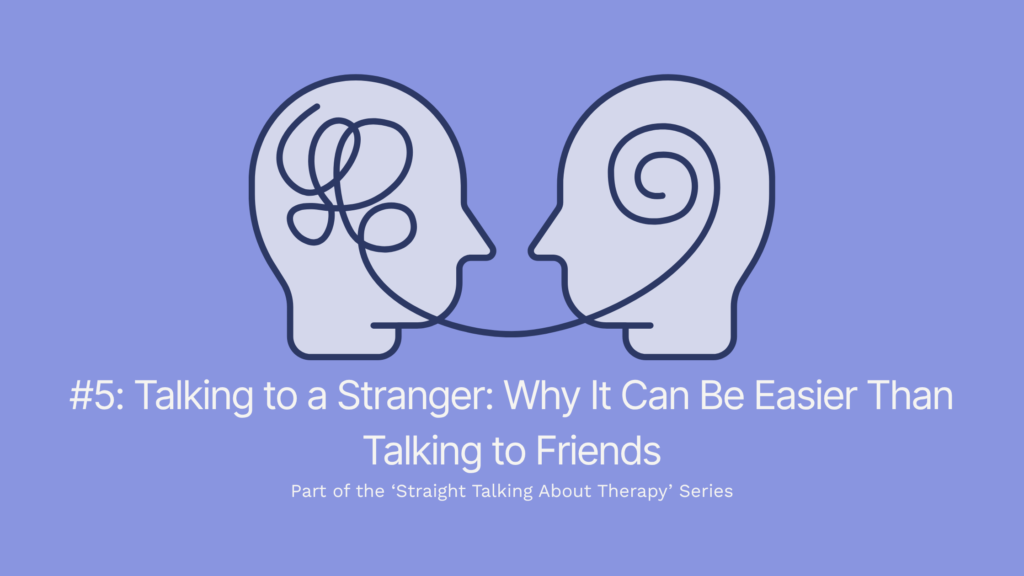
One of the most common objections to counselling is also one of the most understandable.
"Why would I talk to a complete stranger about something so personal?"
On the surface, it seems like a strange idea. Surely the people best placed to support us are those who know us best. Friends, partners, family members and colleagues have often shared years of our lives. They know our history, our personality and the people who matter to us. If we are struggling, shouldn't those relationships be enough?
For many people, they are.
Strong personal relationships can be one of the greatest protective factors for our wellbeing. They provide encouragement, perspective, companionship and support through life's inevitable challenges. Counselling is not intended to replace those relationships, and most therapists would agree that healthy friendships, families and communities remain an essential part of a fulfilling life.
Yet there are times when talking to somebody who knows us well can feel surprisingly difficult.
The people closest to us rarely hear our experiences in isolation. They hear them through the lens of shared history, personal investment and their own feelings about the situation.
If you're considering leaving a job, your partner may immediately think about the financial implications. If you're reflecting on a family conflict, relatives may already have strong opinions about the people involved. If you're struggling emotionally, friends may feel worried, protective or eager to help.
None of this is wrong. In fact, it's often evidence of how much people care.
The challenge is that conversations can sometimes become shaped by these understandable reactions. Before long, you may find yourself managing someone else's concerns, defending your choices or softening what you really think in order to avoid upsetting the people around you.
Many people discover that they are not withholding their thoughts because they lack trust. They are withholding them because the relationship itself matters.
This is one of the things that makes counselling different.
A counsellor is not a participant in your life. They do not have a stake in your decisions and they are not affected by the outcome.
Whether you stay in a relationship or leave it, accept a promotion or turn it down, reconcile with a family member or choose a different path, the counsellor's role remains the same. Their focus is not on directing your decisions but on helping you understand yourself more clearly.
For many people, this neutrality comes as a relief.
It creates a space where thoughts can be explored without feeling that they need to be justified, defended or filtered. Questions that feel confusing, contradictory or uncomfortable can be spoken aloud without the fear of disappointing someone or creating consequences in an existing relationship.
When people imagine counselling, they often assume that the therapist will spend the session offering advice or telling them what they should do.
In reality, most counselling conversations are very different from everyday discussions.
Friends naturally want to solve problems. Family members often want to protect us. Colleagues may offer practical suggestions. These responses usually come from a place of care and concern.
Counsellors, however, are trained to be curious before they are directive.
Rather than telling you what they think, they are more likely to explore what you think. Rather than providing answers, they may help you examine assumptions, uncover patterns or consider perspectives you had not previously recognised.
This can feel unusual at first. Yet many people find that having space to think out loud, without being interrupted by advice, allows them to discover their own answers more effectively than they expected.
There is another reason why speaking to a counsellor can feel easier than talking to someone close to you.
A counsellor meets you in the present.
They are not meeting the version of you that existed ten years ago. They are not viewing you through the lens of family expectations, workplace reputation or friendship dynamics.
Instead, they meet the person sitting in front of them today.
That fresh perspective can be surprisingly powerful. It allows people to explore aspects of themselves that may have become hidden behind long-established roles and identities. The person who is always strong can talk about feeling vulnerable. The person who is always dependable can admit they are exhausted. The person who is known for having all the answers can speak honestly about uncertainty.
Sometimes it is easier to say these things to someone who has no preconceived idea of who you are supposed to be.
It is important to avoid a common misunderstanding.
Therapy is not better than friendship.
Nor is it intended to replace the support of family, community or trusted relationships.
The two simply serve different purposes.
Friends and family walk alongside us through life. They celebrate our successes, share our experiences and often know us better than anyone else ever will.
Counselling offers something different: a confidential, boundaried and professionally focused relationship designed to help you explore your thoughts, feelings and experiences in depth.
Many people benefit from both.
When people say that counselling helped them, they are rarely saying that a stranger had all the answers.
More often, they are describing the experience of having a space where they could speak openly, think freely and feel heard without judgement.
The irony is that counselling is often effective not because the counsellor is a stranger, but because the relationship is intentionally designed to provide something many of us struggle to find elsewhere: a space that's entirely focused on understanding us.
And sometimes, that makes honest conversation much easier than we expect.