
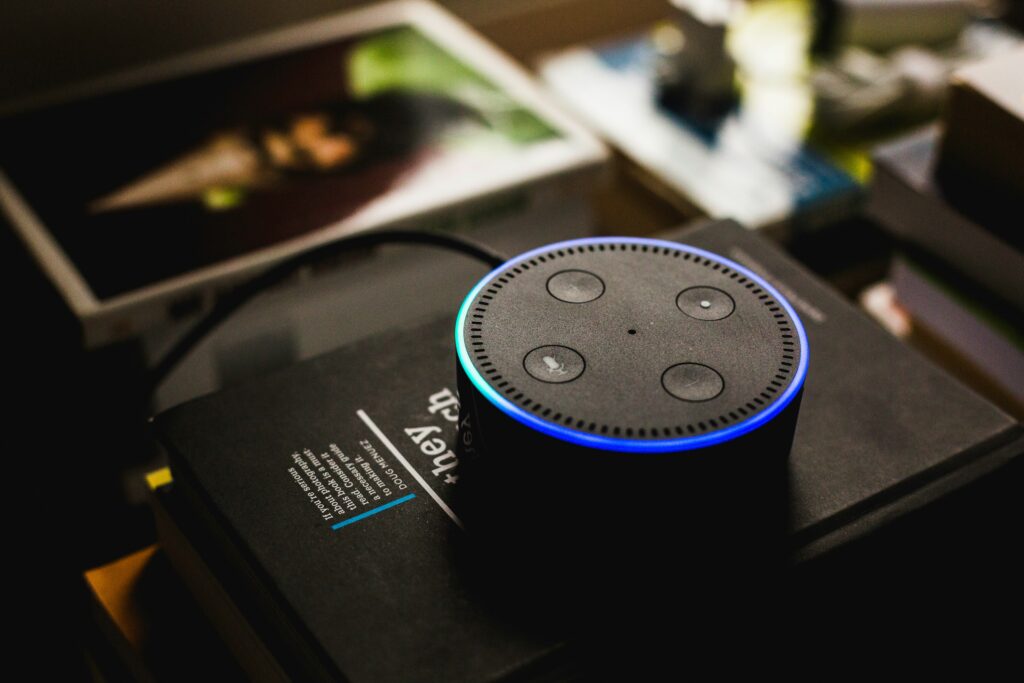
The way people search for information online has changed rapidly. Smart-speakers, virtual assistants, and voice-enabled devices such as Amazon Alexa, Google Assistant, and Microsoft Cortana have made it easier than ever for users to ask questions.
For businesses this means that the tried and tested text-based ways of doing SEO are no longer enough. If you want your copy to be discovered as well as relevant, you need to ensure that it’s optimised for voice search.
If you don’t have voice speech optimisation as part of your content strategy, then you may fall behind your competitor brands.
According to recent statistics, over 30% of British adults are already using digital assistants at least once a day. The survey also found that 29.2% of internet users aged 16-64 use voice assistants each week, with these numbers skewing towards younger demographics.
In other words, the coming generations with the purchasing power of the future are integrating voice assistants into their daily life. These powerful tools are particularly popular with busy professionals, and people with accessibility needs.
Voice search is changing how people search. Because the words are spoken rather than written, people using voice search tend to ask questions in a more conversational way. This means there’s a greater use of long-tail queries rather than single keywords.
Whereas someone might type “best Indian restaurant in Manchester” into a search bar, they might ask their speaker, “Hey Alexa, what’s the best Indian restaurant near me?”
While the distinction might seem subtle, it has significant implications for content creation and copywriting strategies.
Getting your copy ready for the new era of voice is the next step in intelligent, effective SEO.
Key to optimising for voice search is understanding how natural language differs from a typed search. Because they’re conversational, voice queries tend to be longer and will often be based around a question.
That means that words like “how”, “what,” “where,” and “why,” occur more frequently, reflecting the way that people speak when they’re seeking information.
So, the kind of content that will be successful with voice search will be structured to provide direct, concise answers to questions. In practice, that means including FAQ sections, conversational headings, and information rich paragraphs that answer clear questions.
For example, if you run a plumbing company, you might want to include answers to questions such as: “How do I fix a leaking tap?” or “What plumbing services are available in my area?”.
This approach increases the likelihood of a virtual assistant locating your content and reading it aloud when a user asks a related query.
Voice assistants will often source their answers from the featured snippets at the top of search results. These are sometimes called “position zero”, and summarise information in a brief, concise format, such as a list, table, or paragraph.
It’s important to try and optimise copy to give it a better chance of appearing in featured snippets as an essential step in improving your voice search visibility.
In practical terms this means that content needs to:
Designing your content with these principles in mind increases the chance that your information will be identified as authoritative and trustworthy by digital assistants.
Writing copy for voice search is a skill that requires a different approach to traditional SEO.
Some of the key strategies that need to be included are:
Voice speech user statistics are now impossible to ignore.
If your content isn’t optimised for voice searches, then you’re likely to fall behind your competitors, but getting it right isn’t always easy.
Our team of experienced copywriters understand how to make sure content appears in voice searches. We work with clients to ensure they’re ready for a new era of digital assistants and voice search, giving copy that essential human quality that marks it out as trustworthy and compelling.
Contact us to find out more:
Call: 07712 134893
Or email info@aurorascopywriting.com