
For many organisations, workplace wellbeing has traditionally meant having support available when somebody needs it: an Employee Assistance Programme, a helpline, counselling provision or somewhere to signpost an employee who is struggling.
These services can be incredibly valuable. But there is an important question for employers to consider:
What are we doing to support our people before they reach the point of needing them?
That is where proactive workplace wellbeing comes in.
Employee wellbeing is no longer simply a “nice to have”.
The CIPD’s 2025 Health and Wellbeing at Work report found that UK employees were absent for an average of 9.4 days per employee per year – almost two working weeks. That has increased considerably from 5.8 days before the pandemic. Mental ill health is now the leading cause of long-term absence, while stress remains a significant contributor to both short- and long-term absence.
The wider figures are equally striking.
Health and Safety Executive (HSE) statistics show that in 2024/25, 964,000 workers experienced work-related stress, depression or anxiety, resulting in an estimated 22.1 million working days being lost. Across work-related ill health and workplace injuries as a whole, 40.1 million working days were lost.
And absence is only part of the cost.
There is also presenteeism – when somebody is technically at work but poor health or wellbeing means they are unable to perform at their usual level – alongside staff turnover, reduced engagement, conflict and lower productivity.
Deloitte estimates that poor mental health alone costs UK employers around £51 billion a year, with approximately £24 billion attributed to presenteeism. Its research also found that employers receive an average return of around £4.70 for every £1 invested in supporting employee mental health, with early interventions such as education and organisation-wide cultural change delivering particularly strong returns.
The business case for prevention is becoming increasingly difficult to ignore.
There is also a legal responsibility.
The HSE states that employers have a legal duty to protect workers from work-related stress by carrying out a risk assessment and acting on what they find, just as they would with other health and safety risks. For businesses with five or more workers, that risk assessment must be recorded.
HSE guidance identifies six key areas of work that can contribute to stress when they are not managed effectively: demands, control, support, relationships, role and change.
Crucially, the emphasis is increasingly on prevention.
HSE's Working Minds approach encourages employers to recognise pressures, respond to them and make conversations about stress part of normal workplace practice. Its guidance is clear that employers should not simply wait for problems to arise; they should proactively understand the pressures affecting their workforce and take action.
So while providing a helpline or support service for an employee experiencing a crisis has an important place, it should not be the entirety of a workplace wellbeing strategy.
One of the challenges with traditional workplace wellbeing is that it can become focused on individual areas in isolation.
A business might arrange a mental health awareness session. Another might offer discounted gym membership, a fruit bowl or a one-off yoga class.
All of those things can contribute positively – but people don't experience their wellbeing in separate boxes.
Our physical, mental, emotional, social and everyday wellbeing are interconnected. Financial pressures can affect sleep. Poor sleep can affect concentration. Workplace stress can manifest physically. Loneliness can affect mental health. Caring responsibilities, menopause, grief, relationships, nutrition, movement, confidence and a sense of purpose can all influence how somebody feels when they arrive at work.
That is why a more holistic approach matters.
The CIPD recommends that employee wellbeing is integrated throughout an organisation and embedded within its culture, leadership and people management rather than treated as a collection of standalone initiatives. It also advocates a prevention-based approach to addressing risks to health.
There is another element of wellbeing that is harder to measure but incredibly important: how it feels to work somewhere.
Employees want to feel valued, supported, listened to and connected to the people around them.
Workplace culture therefore forms an important part of any meaningful wellbeing strategy.
A wellbeing programme isn't simply about giving employees activities to attend. Done well, it can create opportunities for conversation, connection and shared experiences. It can demonstrate that looking after yourself is encouraged rather than something that needs to be squeezed in around work.
It can also help make wellbeing part of everyday workplace culture rather than something discussed only when somebody is struggling.
Because ultimately, a healthy workplace isn't one where nobody ever experiences difficulty. It is one where people feel able to speak up, where managers recognise potential issues, where support is accessible and where preventative action is taken before challenges escalate.
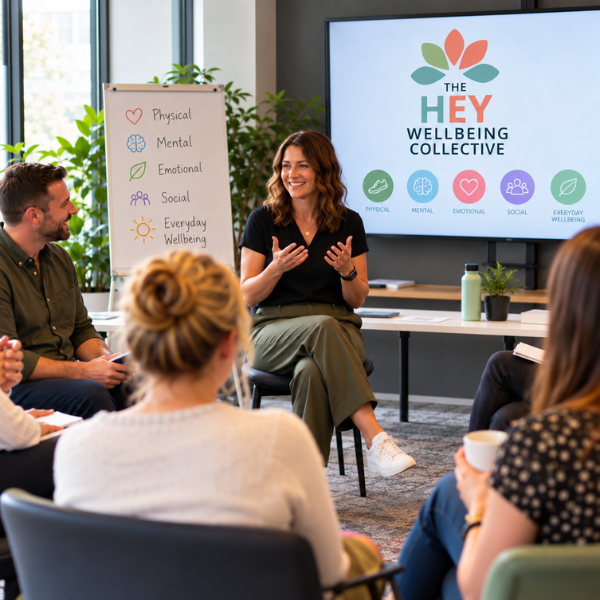
This thinking sits behind The HEY Wellbeing Collective's Workplace Wellbeing Programme.
The HEY Wellbeing Collective brings together independent wellbeing professionals from across Hull and East Yorkshire covering a broad spectrum of wellbeing.
Rather than focusing solely on physical health or mental health, the programme enables local employers to introduce their teams to different forms of support across physical, mental, emotional and everyday wellbeing.
That could include everything from movement, nutrition and physical wellbeing to stress management, breathwork, mindfulness, menopause support, sleep, confidence, resilience, financial wellbeing, creativity and connection.
Because no two employees are the same – and neither are their wellbeing needs.
Through workshops, short wellbeing toolbox sessions, wellbeing clinics and longer-term programmes, businesses can create an approach suited to their workforce rather than relying on a one-size-fits-all solution.
It also means workplace wellbeing can become something employees actively engage with throughout the year, rather than something they discover is available only when they have reached a crisis point.
Reactive support will always have an important role. There will always be times when employees need specialist intervention, occupational health, counselling, medical support or an Employee Assistance Programme.
A proactive programme does not replace those services.
It sits before them.
It asks what organisations can do today to help employees look after themselves, recognise their own needs, build healthier habits, feel connected to their workplace and access support earlier.
For employers, that can contribute to a healthier, more engaged and resilient workforce. For employees, it sends a simple but important message:
Your wellbeing matters here – not just when something goes wrong.
The HEY Wellbeing Collective works with organisations across Hull and East Yorkshire to create flexible workplace wellbeing programmes drawing on the expertise of local wellbeing professionals.
To find out more about bringing a proactive, whole-person approach to wellbeing into your workplace, visit The HEY Wellbeing Collective and explore our Workplace Wellbeing Programme.