
TL;DR - Quick Read
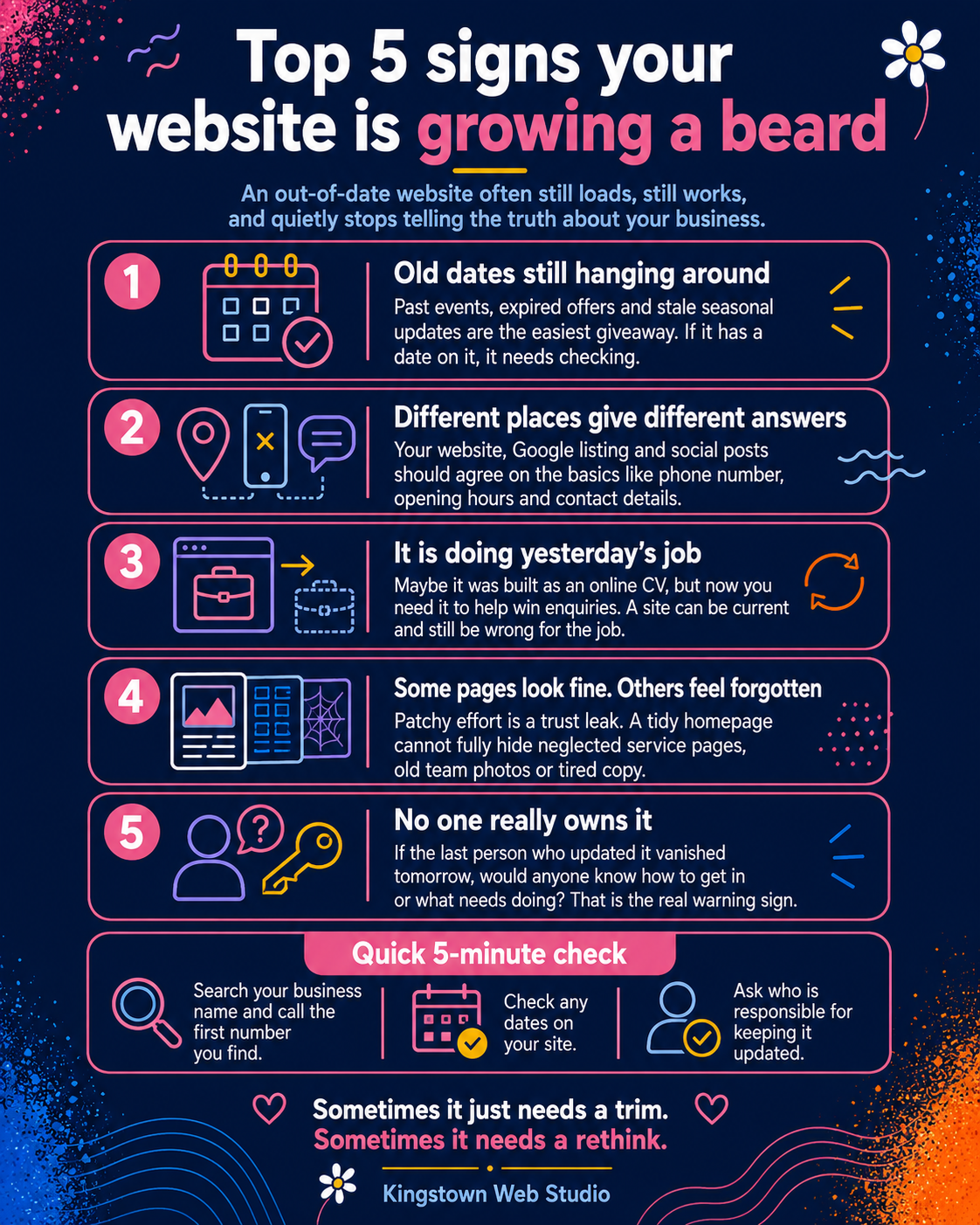
Your website doesn't need to crash to stop working for you. A quick look at local sites recently turned up a pattern worth flagging - stale dates, contact details that don't match, some pages clearly looked after and others left to drift. None of it dramatic. All of it noticed.
I went looking for local events to attend recently. Nothing fancy, just a proper look round at what's on. And I kept hitting the same thing - site after site showing events from a year ago, sometimes more. Not broken. Not down. Just quietly out of date, in a way that's easy to miss if you're not the one looking for it.
Then, separately
I was trying to get through to a local company. Three different phone numbers, three different places - the website, a directory listing, an old social post. I rang all three before I found the one that worked. Neither business had done anything wrong exactly. But both were telling on themselves a bit, if you knew what to look for.

Your website doesn't have to be broken to stop doing its job. It just has to stop telling the truth.
Two patterns, both worth knowing:
› Dates that don't move. Events, offers, seasonal news - anything time-stamped is the easiest tell, because it can't hide its own age.
› Different answers in different places. Same business, three phone numbers. Small on its own, but it's exactly the kind of thing that chips away at trust without anyone clocking why.
Neither is a design problem. Both are a "who's actually keeping an eye on this" problem.
Why it matters more than it looks
76% of people check a business's online presence before visiting in person - even when they've been referred by someone they trust.
75% judge a business's credibility on the website alone.
That's not about scaring anyone off having a website at all. It's just how people actually decide who to try these days. Someone recommends you at the school gates on Monday, and by Monday evening they're having a quick look online to check that recommendation still holds. If what they find doesn't quite match what they expected - a number that's wrong, an event from last year still sitting there - that gap gets noticed. And it gets noticed before you ever get the chance to explain yourself.
Hull's a small enough patch that this stuff gets noticed. Word travels here in a way it doesn't in a bigger city, which cuts both ways - it's exactly why a business with its details straight tends to do well by word of mouth, and exactly why the small inconsistencies matter more here, not less.
More to come
This is the first of a few I'll be sharing here on what actually makes a website worth keeping. Next up: the questions your own site should probably be able to answer, then Trust and Credibility. Worth keeping an eye out if any of this struck a chord.
I've written the whole thing up properly on Web Wise - what to check, why it matters, and a five-minute way to look at your own site with fresh eyes. Read the full piece here →


Susi Hogan is the founder of Kingstown Web Studio, building clear, practical websites for small businesses across Hull and East Yorkshire. She writes about what actually makes a website work, one observation at a time.
Got a question?
Scan to WhatsApp or visit wa.me/447396984711
The examples referenced above are drawn from genuine local observations; no individual business is named or identified.