
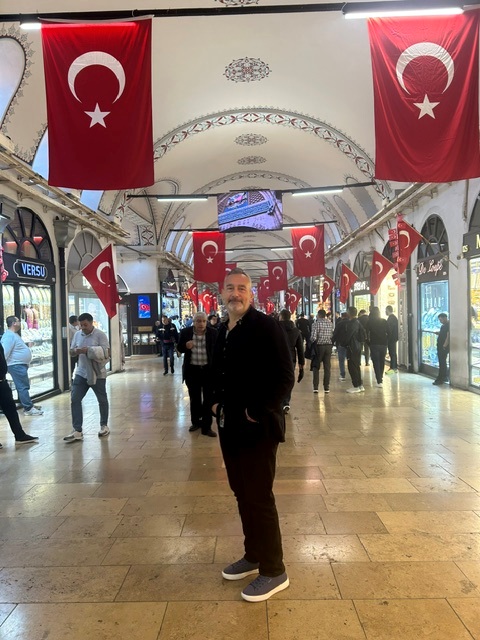
A recent visit to Istanbul has provided new inspiration for Alessandro Caruso, Founder and Co-director of Alessandro Caruso Architects (ACA), as the practice continues to explore how architecture can influence human experience, wellbeing and our relationship with the built environment.
Travelling with his wife and fellow ACA Co-Director Amelia Caruso, Alessandro spent several days exploring Istanbul's extraordinary architectural heritage, from Byzantine landmarks and Ottoman mosques to contemporary cultural buildings.
The journey offered more than an opportunity to admire historic architecture. It provided valuable insights into how buildings, landscapes, culture and human behaviour interact, contributing to ACA's developing research into Relational Architecture.
Istanbul is a city where centuries of history are visible through its architecture. Byzantine engineering, Ottoman traditions and contemporary design coexist within a remarkable urban landscape.
For Alessandro, whose architectural philosophy has long explored the connection between people and their surroundings, the city presented an opportunity to examine how buildings create experiences that extend beyond their physical form.
This approach builds upon ideas explored in his book Design and Meditation and informs ACA's ongoing research into the relationships between architecture, human behaviour and wellbeing.
Rather than considering buildings as isolated structures, the practice is increasingly interested in understanding how their design influences the way people feel, interact and experience everyday life.
Among the landmarks visited were Hagia Sophia, the Blue Mosque, Topkapı Palace and Istanbul's remarkable underground cisterns.
Each offered a different perspective on the relationship between architecture and its users.
At Hagia Sophia, the immense dome and intricate structural arrangement demonstrated how engineering, scale and spatial organisation can combine to create a powerful architectural experience.
The Blue Mosque and its wider historic complex highlighted another important principle: the relationship between buildings and community life.
Traditional Ottoman complexes frequently brought together religious, educational, charitable and social functions, demonstrating how architecture could support several aspects of daily life within a connected setting.
For ACA, whose work includes healthcare, care environments and community facilities, this approach offers a valuable reminder that buildings should respond to wider human needs rather than simply fulfil individual functions.
One of the most memorable experiences was visiting the Basilica Cistern, an underground reservoir constructed during the sixth century.
Originally developed to supply water to Constantinople, the structure has become one of Istanbul's most atmospheric visitor attractions.
Its rows of columns, vaulted ceilings, reflections and carefully considered contemporary lighting create a striking environment.
The smaller Şerefiye Cistern provided another example of how historic infrastructure can take on new cultural significance.
During the visit, a contemporary exhibition inspired by the mythological figure Şahmeran introduced an additional relationship between art, heritage and human storytelling.
For Alessandro, these experiences raised important questions about how existing buildings can be adapted and reinterpreted while retaining their historical character.
They also reinforced the potential for thoughtful conservation and reuse to create meaningful places without losing the qualities that make them distinctive.
At Topkapı Palace, the arrangement of courtyards, entrances and increasingly private spaces illustrated how architectural planning can influence movement, accessibility and social interaction.
The transition between public and private areas demonstrated how buildings communicate different levels of openness, security and privacy.
These observations have particular relevance to contemporary healthcare and community design, where architects must balance accessibility with dignity, independence and personal security.
The experience also highlighted the importance of considering how people move through and interpret their surroundings.
A building's success is not determined solely by its appearance, but also by how comfortably and confidently people can use it.
The visit also included Istanbul Modern, the contemporary art museum designed by Renzo Piano Building Workshop and opened in 2023.
Situated on the waterfront, the museum creates a strong connection between its architecture and the surrounding Bosphorus landscape.
Its rooftop terrace, reflective water features and carefully framed views demonstrate how contemporary buildings can respond to their geographical and cultural setting.
For ACA, the project offered an example of how architectural design can establish a meaningful relationship with the environment rather than simply occupy a site.
The museum's exhibitions also explored themes of identity, memory, nature and social change, encouraging further reflection on how people understand and experience the spaces around them.
Beyond Istanbul's buildings, the city's cultural and spiritual traditions offered another dimension to the visit.
The daily call to prayer, heard across the city, demonstrated how sound and shared cultural experiences can influence the atmosphere of public spaces.
An evening attending a Whirling Dervish ceremony also prompted reflection on the relationship between movement, rhythm, awareness and the perception of space.
These experiences reinforced the idea that architecture is not experienced through sight alone.
Sound, movement, memory, emotion and cultural associations all contribute to how individuals respond to their surroundings.
For designers working in healthcare and wellbeing environments, understanding these influences may offer opportunities to create spaces that better support comfort, reflection and social connection.
The insights gained during the visit contribute to ACA's ongoing exploration of Relational Architecture, an approach that considers the connections between people, buildings, environmental conditions, culture and everyday activities.
The practice is developing methodologies intended to examine these relationships more systematically, including its Relational Environmental Assessment (REA) and Relational Environmental Action Plan (REAP).
These emerging approaches aim to help identify how environmental conditions and the relationships within a building can influence its performance and the experiences of those who use it.
For ACA, this research is particularly relevant to healthcare, mental health, residential care and community environments, where the quality of the built environment can have important implications for people's daily lives.
The objective is to move beyond considering architecture solely in terms of appearance, function and technical performance, towards a more comprehensive understanding of how buildings interact with their users.
Although Istanbul's historic monuments and contemporary cultural buildings differ considerably from the facilities ACA designs, the principles observed during the visit have relevance across many architectural sectors.
The importance of natural light, spatial relationships, accessibility, cultural identity and human experience can inform projects ranging from healthcare facilities and care homes to workplaces and community buildings.
For Alessandro, the journey provided an opportunity to question established approaches and explore new perspectives that could contribute to the practice's future work.
It also demonstrated the value of looking beyond familiar environments and learning from the architectural achievements of different cultures and periods.
As ACA continues to develop its research and design philosophy, experiences such as these help strengthen its commitment to creating buildings that respond thoughtfully to both people and place.
To discover more about ACA's architectural philosophy, projects and research, visit www.aca-i.com.