
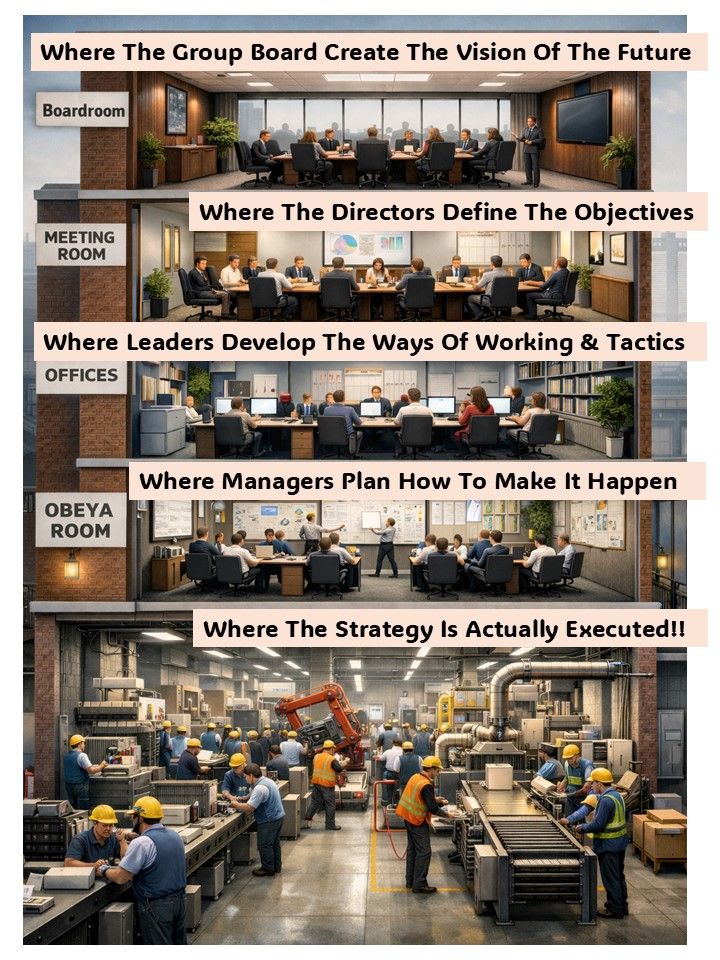
A few years ago, I walked into a small aeronautical engineering business in Dorset. A place with history, skill, and pride - the kind of business that should have been thriving. But within minutes of stepping through the door, I could feel the weight of the place. The car park was overflowing and chaotic. The building was tired. The kitchen was so poor that staff complained about it more than they complained about production issues. Machines sat dormant. Experienced operators weren’t being consulted. Suppliers were letting them down. And management and staff were living in two different worlds.
It wasn’t a bad business. It was a misaligned one.
During my visit, I spoke to people across the factory. One operator told me, “We could have spotted that mistake instantly - nobody asked us.” Another said, “We’re firefighting every day. Nobody’s looking ahead.” A manager admitted, “We don’t really have a process. We just react.” The report reflected the same reality: the factory was “cluttered and untidy; no standards are visible or seen to be enforced,” and maintenance was “run to fail” rather than planned. Staff were “demotivated and disillusioned,” yet still believed the business “has more to offer if managed correctly.”
That last line stayed with me. Because it’s true of so many businesses I visit — from 150‑person factories to sole traders working from a van or a workshop at home.
The problem is the absence of structure, clarity, and alignment.
And that’s when I realised something important: most businesses don’t fail because of one big issue. They fail because of a thousand small ones nobody is measuring. Even one‑person businesses suffer from this — it just shows up differently. Instead of misaligned teams, it becomes misaligned priorities. Instead of dormant machines, it becomes dormant opportunities. Instead of poor communication between departments, it becomes poor communication with yourself: “I’ll sort that later,” “I’ll get more organised next month,” “I’ll fix that when things calm down.”
Things rarely calm down or fix themselves!
After years of walking into businesses like the Dorset site — manufacturing, engineering, food, distribution - I started to see the same patterns everywhere. Safety issues nobody talks about. Quality that depends on who’s on shift. Costs are quietly leaking out of the business. People are unclear on roles. Culture shaped by frustration rather than intention. And for sole traders, the same themes appear in different clothing: no clear pricing structure, no consistent process, no time to step back, no system for managing work, no clarity on what’s profitable and what’s not.
That’s why I built the SQCP+C™ framework - a structured, scored, on‑site diagnostic designed to give any business, large or small, a clear picture of where it stands. It asks the questions most people avoid. It exposes the gaps that quietly drain profit. And it gives leaders — whether they manage 200 people or just themselves - a simple, colour‑coded view of what needs to change first.
The five pillars are straightforward but powerful.
Safety & Legal Compliance: “Are you sitting on a claim you can’t defend?”
Quality & Process: “Does quality depend on the individual, or the system?”
Cost & Efficiency: “Where is the business bleeding time and money without realising it?”
People & Structure: “Do the right people have the right clarity?”
Culture: “Culture is what emerges when the other four pillars are right.” Each pillar is scored 0–4 per question, producing a total score out of 100, with findings colour‑coded so priorities are immediately clear.
The Dorset business wasn’t broken — it was blind. Machines idle because nobody planned properly. Operators not consulted on technical decisions. A contract review meeting with “no set agenda or dedicated leader.” A factory where “no standards are visible or enforced.” A team with passion, but no direction. And the saddest part? They had everything they needed to succeed — except alignment.
The same is true for sole traders. You may not have a team to misalign, but you can still misalign yourself. You can still lose money without noticing. You can still run inefficiently. You can still burn out. You can still operate without clarity. And you can still drift into habits that quietly limit your potential.
This is exactly why I offer a “Free Tier 0 Visit”. And yes — I know the word “free” makes people suspicious. I hear it all the time. “If it’s free, there must be a catch.” “What’s the upsell?” “What’s the hook?” The truth is simpler: most business owners don’t need a sales pitch. They need clarity. They need someone neutral to walk their site, ask the right questions, and help them see what they’ve stopped seeing. They need a reset button. And clarity shouldn’t be behind a paywall.
The free visit is half a day on site, across all five pillars, no cost, no obligation, no report — just an honest conversation about what’s really going on. It works just as well for sole traders or limited companies as it does for a 100‑person factory. Because clarity scales. Structure scales. Confidence scales. And the smallest businesses often benefit the most.
If you’re a local business owner — whether you run a factory, a workshop, a consultancy, or a one‑person operation - you don’t need to be perfect. You don’t need to tidy up before I visit. You don’t need to have all the answers. You just need to be willing to look. Because businesses rarely fail because of one big thing. They fail because nobody is measuring the small things. And that’s exactly what SQCP+C™ was built to fix.
If you want a conversation - not a pitch - I’m here. Sometimes the smallest conversation unlocks the biggest shift.
Conrad Corbyn
CC‑Limited.com